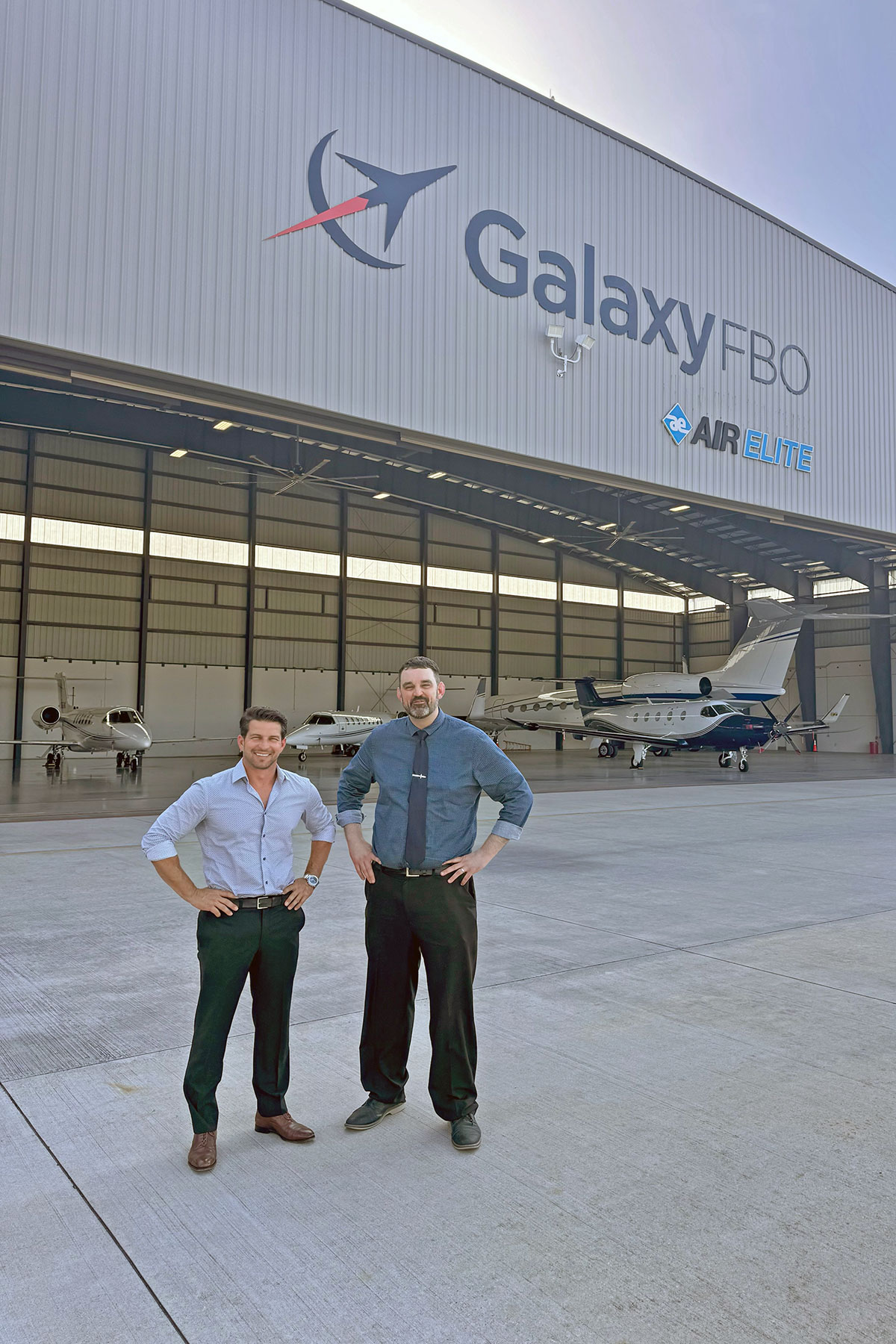
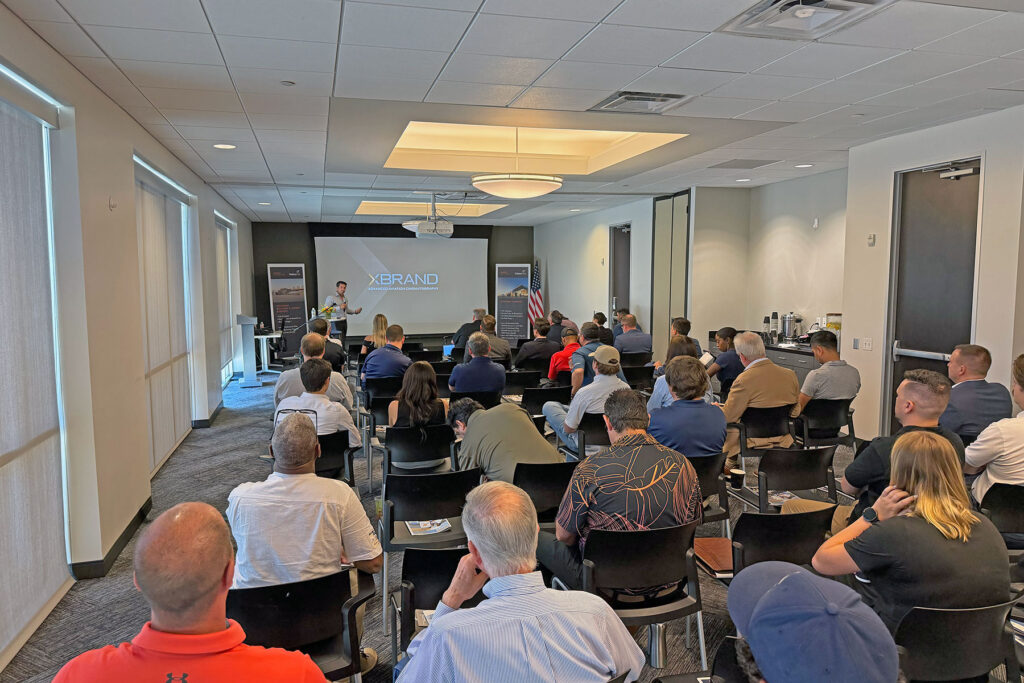
Galaxy FBO recently welcomed Kevin LaRosa to our Conroe-North Houston Regional Airport (CXO) location as a featured speaker at the South Texas Business Aviation Association (STXBAA) Houston Area Safety Day. His presentation, “Soaring to Success: Building Trust, Safety, and Collaboration in High-Stakes Filmmaking,” offered a fascinating perspective on how preparation, communication and teamwork make some of aviation’s most complex operations possible.
LaRosa is one of the motion picture industry’s leading aerial coordinators and stunt pilots. An Airline Transport Pilot with experience across airplanes, helicopters and jets, his credits span more than 100 motion picture and commercial productions, including Top Gun: Maverick, The Avengers, Iron Man and Transformers. His work on Top Gun: Maverick included coordinating highly complex aerial sequences, working with the U.S. Navy, helping prepare the cast for the aviation environment, and utilizing specialized aerial camera platforms to capture some of the film’s signature flying sequences. While Hollywood may provide the backdrop, the principles behind LaRosa’s work are familiar to anyone in professional aviation: plan thoroughly, communicate clearly, understand the risks, trust your team and never allow the mission to compromise safety.
Dan Scanlan, Galaxy FBO’s Director of Safety & Quality had to opportunity to ask Kevin his perspective on aviation safety and what pilots, flight departments and aviation professionals can learn from operating in an environment where there may be only one opportunity to get the shot right.
[Dan Scanlan] Your work can involve multiple aircraft, camera platforms, pilots and production teams operating simultaneously. Before anyone takes off, what does the safety planning process look like on the ground?
For us, the safety process begins long before an aircraft starts. We first define exactly what the creative team wants to accomplish and then translate that creative objective into a disciplined aviation operation.
We identify the aircraft, crews, airspace, terrain, weather, performance limitations and emergency considerations. From there, we establish clear roles, communication procedures, operating boundaries and abort criteria. Everyone must understand not only the plan, but also what every other aircraft and department is expected to do.
Before takeoff, we conduct a detailed briefing and remove as much ambiguity as possible. If the plan cannot be clearly explained and understood on the ground, it is not ready to be attempted in the air. The shot may be creative, but the operation cannot be improvised. We never allow the pressure to get the shot to override the discipline required to get everyone home safely.
[Dan Scanlan] You’ve described using a “crawl, walk, run” approach when developing challenging aerial sequences. How does that philosophy work in practice, and how could pilots and flight departments apply the same mindset to everyday aviation operations?
“Crawl, walk, run” means complexity is earned incrementally. We begin with the simplest version of the maneuver. We may talk through it, rehearse it on the ground, fly it at greater separation or perform it at a slower speed. Once the team demonstrates proficiency and communicates effectively, we introduce the next layer of complexity.
The same principle applies directly to business aviation. When introducing a new aircraft, airport, procedure or crewmember, avoid combining every new variable on the first flight. Build familiarity progressively and create opportunities to identify problems while the task is still simple and the margins are generous.
The objective is not merely to prove that something can be done; it is to develop a method that can be repeated safely and predictably. Repetition builds confidence, but disciplined progression builds capability.
[Dan Scanlan] In business aviation, we often talk about how complacency can develop around operations we perform routinely. In your world, how do you keep a team disciplined and safety-focused?
Complacency often appears when experience makes something feel easier than it actually is. Familiarity does not reduce the risk; it can simply reduce our awareness of it.
We continue to brief routine operations, use checklists and identify what is different about today’s mission. The aircraft may be familiar, but the weather, personnel, environment or operational pressure may have changed. I also try to preserve a healthy level of professional skepticism by asking: What has changed? What are we missing? Where are we most exposed today?
Experience should make us more disciplined, not more casual. The moment an operation feels too routine to brief is often the moment it most needs to be briefed.
[Dan Scanlan] Communication is critical when working together. What have you learned about creating an environment where anyone on the team feels empowered to speak up when something doesn’t look or feel right?
That begins with leadership. You cannot tell people to speak up and then punish them—directly or indirectly—when they do.
At the beginning of an operation, I make it clear that every person has the authority and responsibility to raise a concern or call a stop. Rank, title and experience do not matter when someone sees something the rest of us may have missed. When someone speaks up, the first response should be, “Thank you—let’s take a look.” Even if the concern ultimately proves insignificant, raising it was still the correct behavior.
A strong safety culture is not one in which the leader has all the answers. It is one in which the leader creates enough trust for the entire team to contribute. I would rather answer an uncomfortable question on the ground than face an unanswered problem in the air.
[Dan Scanlan] Technology in the cockpit and in aerial cinematography has changed dramatically throughout your career. How do you take advantage of new technology without allowing it to replace basic airmanship, situational awareness and sound judgment?
I see technology as a force multiplier, not a substitute for judgment. Modern avionics, stabilized camera systems, flight tracking and communication tools give us capabilities that would have been unimaginable earlier in my career. But technology is only valuable when the operator understands what it is doing, what it is not doing and how it can fail.
We train to use the technology while continuing to protect the fundamentals: aircraft control, situational awareness, communication, energy management and sound decision-making. Pilots must remain ahead of the aircraft rather than becoming passengers who simply monitor a collection of systems.
The best technology reduces workload and improves awareness; it should never reduce engagement. Technology can provide more information, but it cannot assume responsibility for the decision.
Safety Is a Team Effort
From a Hollywood film set to a corporate flight department, aviation safety ultimately depends on people. Technology, procedures and equipment continue to evolve, but preparation, communication, sound judgment and a willingness to speak up remain fundamental.
We thank Kevin “K2” LaRosa for visiting Galaxy FBO in North Houston, sharing his experiences with the South Texas aviation community, and offering a different perspective on what it takes to safely accomplish an extraordinary mission.
At Galaxy FBO, we’re proud to support organizations such as STXBAA that bring aviation professionals together to share knowledge, strengthen our industry and continue advancing a culture of safety.